HISTORY OF THE BARC
Formed in 1912 as The Cyclecar Club, today the British Automobile Racing Club organises races at almost every venue in Britain, including meetings at Anglesey, Brands Hatch, Cadwell Park, Croft, Donington Park, Lydden Hill, Mallory Park, Oulton Park, Pembrey (Wales), Silverstone, Snetterton, and of course the BARC's home circuit, Thruxton.
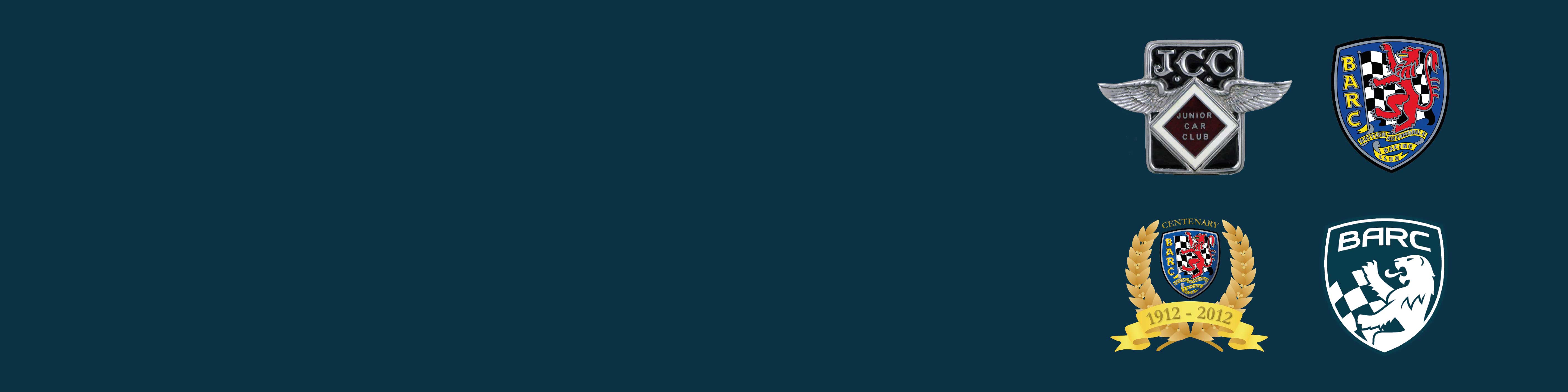
The Cyclecar Club - cyclecars incidentally were light fragile looking devices powered by motorcycle engines - grew quickly and organised events at Brooklands as well as rallies and touring trials on the open road. In 1919, following World War One, with cyclecars on the decline, the name was changed to The Junior Car Club. Club members owned light cars, which were defined as four seater's weighing less than 15cwt., or two-seater's weighing less than 13cwt. Both categories had an engine capacity limit of less than 1500cc (four stroke) or 1100cc (two stroke).
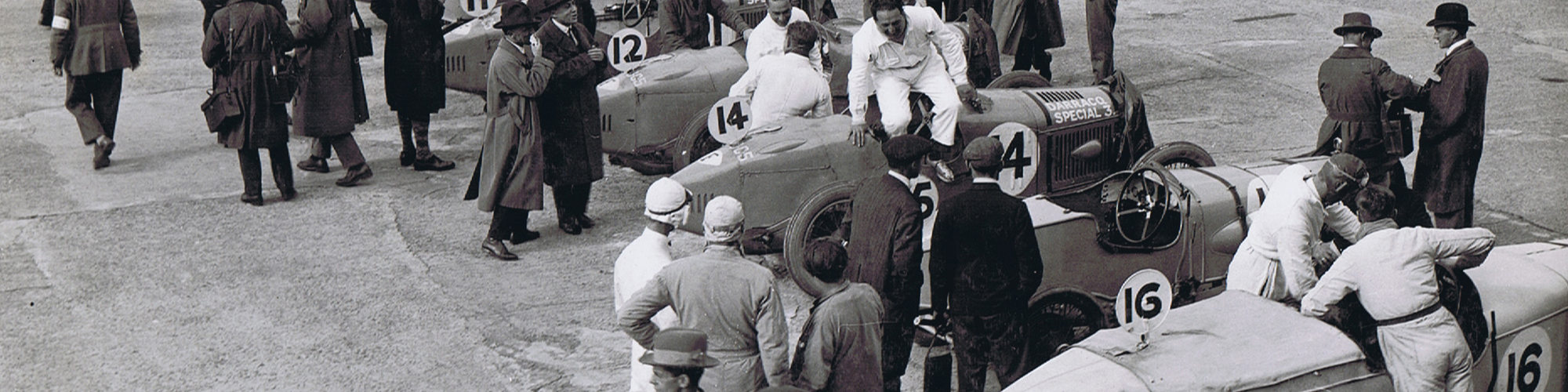
Membership grew quickly. A Secretary and Staff were appointed in 1921, and regional centres were formed in the North, South West, Yorkshire and North Wales. Others were due to follow. In 1921 the JCC organised the first long-distance race ever run in Britain, the 200 Mile Race at Brooklands, won by Henry Seagrave's Talbot-Darracq.
The 200 was run at Brooklands until 1928. From 1925 chicanes were added to simulate a road course. From 1929 to 1931 the Double 12 Hour Race was the highlight of the JCC calendar. In 1932, a 1000 Mile Race, also organised at Brooklands, was won by Elsie Wisdom and Joan Richmond in a Riley. The JCC was one of the first clubs to allow women to compete against men.
From 1933 to 1939 a series of International Trophy Races was organised at Brooklands, while the 200 Mile Race was revived at Donnington Park in 1936 and 1937, transferring back to Brooklands the following year. Rallies were also organised, including The British Rally to the United States and Canada held in 1936 and 1939.
After the Second World War, the Junior Car Club was amalgamated with the Brooklands Automobile Racing Club - Brooklands as a racing venue was gone forever. In conjunction with The Jersey Motorcycle and Light Car Club, the Jersey International Road Race was organised in 1947 and repeated in 1949, 1950 and 1952. The new home of the club, with its name changed in 1949 to The British Automobile Racing Club, was the Goodwood circuit on the outskirts of Chichester in West Sussex.
Goodwood was the venue of many important BARC promotions, with at least one International fixture each year until the circuit was closed on public safety grounds in 1966. Easter Monday Internationals often featured a Formula 1 race. In 1952, 1953 and 1955 a nine-hour sports car race was run, the first after-dark racing ever organised in Britain.
The BARC was in at the reopening of Crystal Palace in 1953 and the opening of Aintree the following year. Indeed, when the British Grand Prix was run at Aintree in 1955, 1957, 1959, 1961 and 1962 the BARC was the organiser. The 1955 race witnessed Stirling Moss' first ever World Championship Grand Prix win, and two years later Moss took over team mate Tony Brooks' Vanwall to make another mark in the history books: it was the first World Championship Grand Prix win for a British car, and the first Grand Epreuve victory for a British car since the 1920's.
The RAC's classic Tourist Trophy sports car race was revived by the BARC at Goodwood in 1958, and the nail-biting 1959 race saw that man Moss clinch the World Sports Car Championship for Aston Martin. He took over the car of Carroll Shelby and Jack Fairman after his own caught fire during a pit stop.
Goodwood's closure was serious; the BARC had no "home". The 1967 Easter Monday International was switched temporarily to Silverstone, while its new circuit, Thruxton, was transformed from a bleak wartime airfield into a permanent motor racing facility.
Since its opening in 1968 the Hampshire circuit has developed into one of the major circuits in the country and since 1974, the BARC Headquarters have been at the Track. New pits were constructed in 1984 and the track resurfaced in 1987. Major meetings of each year included the Easter Monday Formula 2 race, counting towards the European Championship until its demise in 1984, and always hotly contested, while there were also major races for the British Formula 1 Championship, and saloon car championships. In 1986 a round of the new Formula 3000 Championship, successor to Formula 2, was run at Thruxton but not thereafter because of its financial structure.
Regularly each year rounds of the prestigious British Formula 3 Championship are run at the circuit, and also rounds of the British Touring Car Championship, the two series contributing to the continued major status of Thruxton.
Recently, the BARC has been instrumental in introducing several important new formulae to the circuits : Formula Vauxhall Lotus in 1988, Formula Renault in 1989, and Formula BMW in 2004. There is a similar story with the Saloon cars, including the Renault Clio Championship and the SEAT Championship.
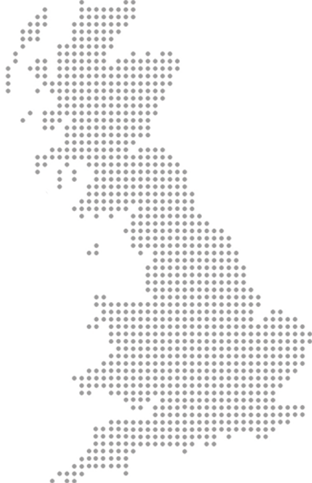
The club currently has seven active centres throughout the country, based in the following areas : East Anglia - Norwich; South East - London; Midlands - Leicester; North West - Liverpool; South West - Southampton; Yorkshire - Leeds; Wales - Llanelli; plus circuits at Thruxton in Hampshire, Pembrey in Dyfed, Mallory Park in Leicestershire, Croft in North Yorksire and hillclimb venues at Gurston Down near Salisbury (Wiltshire) and Harewood Hill near Leeds (West Yorkshire).
On the social side, the BARC organised its first Beaujolias Challenge in 1981. This very popular fun motoring event, which ran every year up to 1997, started at Lacenas in France on dates which co-incided with the annual release of the Beaujolais Nouveau and raised a considerable amount of money for charity.
Yet another milestone in the Club's history came in 1990, when BARC signed a 50 year lease on Pembrey Circuit in South Wales, having run the first car race meeting on the former airfield track in the previous year. During the following two years race administration buildings and a restuarant were erected, and 1992 saw the first visit of British Formula 3 and British Touring Car Championships to the circuit.
1992 also marked the BARC's 80th anniversary, celebrated with a Ball at Goodwood House in October.
In June 1993, following an idea from BARC Council member Ian Bax, a hillclimb event called the Festival of Speed for cars and motorcycles of different eras, was held at Goodwood House, the home of the BARC president, The Earl of March. The following year the Goodwood Festival of Speed celebrated 100 years of motorsport. The now annual event has grown into what is described by the press as the premier event in the Historic motorsport world calendar.
Cars such as Auto Union and BRM through to the latest Le Mans and Formula 1 machinery from McLaren, Williams and Ferrari are flown in from around the world to be driven by stars such as Moss, Surtees, Gonzales and current Grand Prix and GT stars.
August 1995 saw the Club organising the BBC Top Gear World Electric Challenge at Mallory Park, featuring a round of the FIA Electro-Solar Cup 1995 - the first ever race meeting for electrically-powered vehicles run under FIA rules in the UK.
In July 1995 at Donington, the BARC organised the first ever UK round of the FIA International Touring Car series. With the main race organisers in Germany and support races coming from Italy (Maserati), France (Eurocup Renault Clio) and elsewhere this was a truly international event that called for immense planning and organisation. Furthermore, with qualifying and racing being broadcast live, the timetable had to be strictly adhered to. The BARC are responsible for organising some of the highest International race meetings in Europe and have one of the best worldwide reputations for race meeting organisation and promotion. The complete success of these, plus other races organised by BARC is well documented by the media.
Following the death of Ian Taylor, the BARC purchased during 1998 the Ian Taylor Motor Racing School (now trading as the Thruxton Motorsport Centre), and have developed this school into a first class "experience" centre, offering drives in both exciting and exotic machinery such as Formula Renault Single Seater racing cars, and Ferrari and Lamborghini sports cars. A purpose-built Karting centre and Four-Wheel-Drive facility have also been added to the Thruxton Motorsport Centre's portfolio.
Early in 2005, the BARC purchased Mallory Park (Motorsport) Ltd., the company which arranges motor sport at the Mallory Park circuit, thereby effectively taking control of all circuit and track activities at the Leicestershire circuit.
In the same year, the BARC were also able to purchase the Company who operate the British Touring Car Championship, thereby adding another prestige Championship to its portfolio.
During late 2006, the company invested in the purchase of Croft PromoSport Ltd, previously owned by the Croft Estate in the North of England, and has therefore taken over all the motor sport activities at the Croft circuit near Darlington.
All of these investments hold great promise for the BARC, broaden the geographical and operational spread of our existing activities, and further enhances the club's standing within the motor-racing industry.
The BARC will forever continue in its aim to be the best!